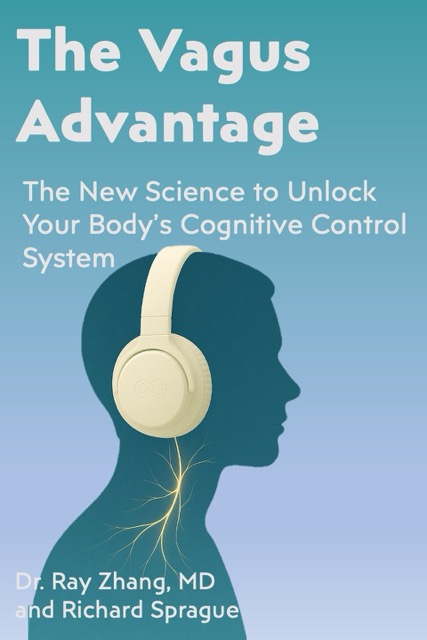
The book you hold in your hands represents the culmination of thousands of hours of research, clinical observation, and technological development by a dedicated team committed to advancing our understanding of neural regulation and its practical applications. “The Vagus Advantage” is not merely an academic exercise but a bridge between cutting-edge neuroscience and everyday wellness—a guide to harnessing the remarkable potential of vagus nerve stimulation in our increasingly demanding world.
Our journey began with a simple yet profound observation: the human nervous system, particularly the vagus nerve, holds untapped potential for improving how we manage stress, enhance cognitive performance, and recover from the demands of modern life. This “neural highway” that connects brain and body offers a gateway to influencing our most essential physiological functions—from heart rate and digestion to attention and emotional regulation.
This work stands on the shoulders of pioneers in neuroscience who have illuminated the intricate mechanisms of neural function. We owe a particular debt of gratitude to Dr. Robert Desimone, Director of the McGovern Institute and Doris and Don Berkey Professor of Brain and Cognitive Sciences, whose groundbreaking research on attention mechanisms has fundamentally shaped our understanding of how the brain processes information. As Dr. Desimone eloquently observes:
This powerful metaphor of neural synchronization—a “chorus rising above the noise”—captures beautifully what vagus nerve stimulation offers: a means to orchestrate our neural activity more harmoniously, enhancing signal over noise in both brain and body. The technology we explore in this book draws inspiration from this understanding, offering a non-invasive approach to influencing these natural neural rhythms.
We have written this book for a diverse audience: healthcare professionals seeking additional tools for patient care, researchers interested in the intersection of neuroscience and wellness technology, and individuals looking to take a more active role in managing their mental and physical wellbeing. Whether you approach this subject with scientific curiosity, professional interest, or personal motivation, we believe you’ll find valuable insights in the pages that follow.
Throughout this book, we maintain a commitment to scientific integrity while acknowledging that we stand at the frontier of an evolving field. We present the established research alongside emerging findings, always distinguishing between what is known with certainty and what remains promising but preliminary. Our goal is not to oversell the technology’s capabilities but to present a balanced assessment of its current applications and future potential.
The journey from laboratory discovery to practical, everyday technology is rarely straightforward. As you’ll discover in these pages, vagus nerve stimulation has traveled a fascinating path from clinical treatment for specific medical conditions to a broader tool for wellness optimization. We invite you to explore this journey with us and consider how these advances might enhance your professional practice or personal wellbeing.
Addorisio, Meghan E., Gavin H. Imperato, Alex F. De Vos, Steve Forti, Richard S. Goldstein, Valentin A. Pavlov, Tom Van Der Poll, et al. 2019.
“Investigational Treatment of Rheumatoid Arthritis with a Vibrotactile Device Applied to the External Ear.” Bioelectronic Medicine 5 (1): 4.
https://doi.org/10.1186/s42234-019-0020-4.
Alkhawajah, Hani A., Ali M. Y. Alshami, and Ali M. Albarrati. 2024.
“The Impact of Autonomic Nervous System Modulation on Heart Rate Variability and Musculoskeletal Manifestations in Chronic Neck Pain: A Double-Blind Randomized Clinical Trial.” Journal of Clinical Medicine 14 (1): 153.
https://doi.org/10.3390/jcm14010153.
Badran, Bashar W., Logan T. Dowdle, Oliver J. Mithoefer, Nicholas T. LaBate, James Coatsworth, Joshua C. Brown, William H. DeVries, Christopher W. Austelle, Lisa M. McTeague, and Mark S. George. 2018.
“Neurophysiologic Effects of Transcutaneous Auricular Vagus Nerve Stimulation (taVNS) via Electrical Stimulation of the Tragus: A Concurrent taVNS/fMRI Study and Review.” Brain Stimulation 11 (3): 492–500.
https://doi.org/10.1016/j.brs.2017.12.009.
Bolz, Armin, and Lars-Oliver Bolz. 2022.
“Technical Aspects and Future Approaches in Transcutaneous Vagus Nerve Stimulation (tVNS).” Autonomic Neuroscience 239 (May): 102956.
https://doi.org/10.1016/j.autneu.2022.102956.
Bremner, James Douglas, Nil Z. Gurel, Matthew T. Wittbrodt, Mobashir H. Shandhi, Mark H. Rapaport, Jonathon A. Nye, Bradley D. Pearce, et al. 2020.
“Application of Noninvasive Vagal Nerve Stimulation to Stress-Related Psychiatric Disorders.” Journal of Personalized Medicine 10 (3): 119.
https://doi.org/10.3390/jpm10030119.
Bubl, Emanuel, Elena Kern, Dieter Ebert, Michael Bach, and Ludger Tebartz Van Elst. 2010.
“Seeing Gray When Feeling Blue? Depression Can Be Measured in the Eye of the Diseased.” Biological Psychiatry 68 (2): 205–8.
https://doi.org/10.1016/j.biopsych.2010.02.009.
Canli, Turhan, Rebecca E. Cooney, Philippe Goldin, Maulik Shah, Heidi Sivers, Moriah E. Thomason, Susan Whitfield-Gabrieli, John D. E. Gabrieli, and Ian H. Gotlib. 2005.
“Amygdala Reactivity to Emotional Faces Predicts Improvement in Major Depression.” NeuroReport 16 (12): 1267–70.
https://doi.org/10.1097/01.wnr.0000174407.09515.cc.
Canli, Turhan, Heidi Sivers, Moriah E. Thomason, Susan Whitfield-Gabrieli, John D. E. Gabrieli, and Ian H. Gotlib. 2004.
“Brain Activation to Emotional Words in Depressed Vs Healthy Subjects:” NeuroReport 15 (17): 2585–88.
https://doi.org/10.1097/00001756-200412030-00005.
Cao, Rui, Iman Azimi, Fatemeh Sarhaddi, Hannakaisa Niela-Vilen, Anna Axelin, Pasi Liljeberg, and Amir M Rahmani. 2022.
“Accuracy Assessment of Oura Ring Nocturnal Heart Rate and Heart Rate Variability in Comparison With Electrocardiography in Time and Frequency Domains: Comprehensive Analysis.” Journal of Medical Internet Research 24 (1): e27487.
https://doi.org/10.2196/27487.
Capilupi, Michael J., Samantha M. Kerath, and Lance B. Becker. 2020.
“Vagus Nerve Stimulation and the Cardiovascular System.” Cold Spring Harbor Perspectives in Medicine 10 (2): a034173.
https://doi.org/10.1101/cshperspect.a034173.
Chai, Xiaoqian J., Dina Hirshfeld-Becker, Joseph Biederman, Mai Uchida, Oliver Doehrmann, Julia A. Leonard, John Salvatore, et al. 2015.
“Functional and Structural Brain Correlates of Risk for Major Depression in Children with Familial Depression.” NeuroImage: Clinical 8: 398–407.
https://doi.org/10.1016/j.nicl.2015.05.004.
Constable, Paul A., Jeremiah K. H. Lim, and Dorothy A. Thompson. 2023.
“Retinal Electrophysiology in Central Nervous System Disorders. A Review of Human and Mouse Studies.” Frontiers in Neuroscience 17 (August): 1215097.
https://doi.org/10.3389/fnins.2023.1215097.
Danthine, Venethia, Lise Cottin, Alexandre Berger, Enrique Ignacio Germany Morrison, Giulia Liberati, Susana Ferrao Santos, Jean Delbeke, Antoine Nonclercq, and Riëm El Tahry. 2024.
“Electroencephalogram Synchronization Measure as a Predictive Biomarker of Vagus Nerve Stimulation Response in Refractory Epilepsy: A Retrospective Study.” Edited by Ayataka Fujimoto.
PLOS ONE 19 (6): e0304115.
https://doi.org/10.1371/journal.pone.0304115.
Ding, Xinfang, Xinxin Yue, Rui Zheng, Cheng Bi, Dai Li, and Guizhong Yao. 2019.
“Classifying Major Depression Patients and Healthy Controls Using EEG, Eye Tracking and Galvanic Skin Response Data.” Journal of Affective Disorders 251 (May): 156–61.
https://doi.org/10.1016/j.jad.2019.03.058.
Ertürk, Çağıl, and Ali Veysel Özden. 2025.
“Comparison of the Acute Effects of Auricular Vagus Nerve Stimulation and Deep Breathing Exercise on the Autonomic Nervous System Activity and Biomechanical Properties of the Muscle in Healthy People.” Journal of Clinical Medicine 14 (4): 1046.
https://doi.org/10.3390/jcm14041046.
Fang, Xi, Hong-Yun Liu, Zhi-Yan Wang, Zhao Yang, Tung-Yang Cheng, Chun-Hua Hu, Hong-Wei Hao, et al. 2021.
“Preoperative Heart Rate Variability During Sleep Predicts Vagus Nerve Stimulation Outcome Better in Patients With Drug-Resistant Epilepsy.” Frontiers in Neurology 12 (July): 691328.
https://doi.org/10.3389/fneur.2021.691328.
Farmer, Adam D., Adam Strzelczyk, Alessandra Finisguerra, Alexander V. Gourine, Alireza Gharabaghi, Alkomiet Hasan, Andreas M. Burger, et al. 2021.
“International Consensus Based Review and Recommendations for Minimum Reporting Standards in Research on Transcutaneous Vagus Nerve Stimulation (Version 2020).” Frontiers in Human Neuroscience 14 (March): 568051.
https://doi.org/10.3389/fnhum.2020.568051.
Farrand, Ariana, Vincent Jacquemet, Ryan Verner, Misty Owens, and Eric Beaumont. 2023.
“Vagus Nerve Stimulation Parameters Evoke Differential Neuronal Responses in the Locus Coeruleus.” Physiological Reports 11 (5): e15633.
https://doi.org/10.14814/phy2.15633.
Forte, Giuseppe, Francesca Favieri, Erik Leemhuis, Maria Luisa De Martino, Anna Maria Giannini, Luigi De Gennaro, Maria Casagrande, and Mariella Pazzaglia. 2022.
“Ear Your Heart: Transcutaneous Auricular Vagus Nerve Stimulation on Heart Rate Variability in Healthy Young Participants.” PeerJ 10 (November): e14447.
https://doi.org/10.7717/peerj.14447.
Galin, Shir, and Hanna Keren. 2024.
“The Predictive Potential of Heart Rate Variability for Depression.” Neuroscience 546 (May): 88–103.
https://doi.org/10.1016/j.neuroscience.2024.03.013.
Genç, Ahmet, Firdevs Ezgi Uçan Tokuç, and Meltem Korucuk. 2024.
“Effects of Vagal Nerve Stimulation Parameters on Heart Rate Variability in Epilepsy Patients.” Frontiers in Neurology 15 (October): 1490887.
https://doi.org/10.3389/fneur.2024.1490887.
Gotlib, Ian H., Heidi Sivers, John D. E. Gabrieli, Susan Whitfield-Gabrieli, Philippe Goldin, Kelly L. Minor, and Turhan Canli. 2005.
“Subgenual Anterior Cingulate Activation to Valenced Emotional Stimuli in Major Depression.” NeuroReport 16 (16): 1731–34.
https://doi.org/10.1097/01.wnr.0000183901.70030.82.
Hartmann, Ralf, Frank M. Schmidt, Christian Sander, and Ulrich Hegerl. 2019.
“Heart Rate Variability as Indicator of Clinical State in Depression.” Frontiers in Psychiatry 9 (January): 735.
https://doi.org/10.3389/fpsyt.2018.00735.
Jensen, Mette Kjeldsgaard, Sally Søgaard Andersen, Stine Søgaard Andersen, Caroline Hundborg Liboriussen, Salome Kristensen, and Mads Jochumsen. 2022.
“Modulating Heart Rate Variability Through Deep Breathing Exercises and Transcutaneous Auricular Vagus Nerve Stimulation: A Study in Healthy Participants and in Patients with Rheumatoid Arthritis or Systemic Lupus Erythematosus.” Sensors 22 (20): 7884.
https://doi.org/10.3390/s22207884.
Jiao, Yue, Xiao Guo, Man Luo, Suxia Li, Aihua Liu, Yufeng Zhao, Bin Zhao, et al. 2020.
“Effect of Transcutaneous Vagus Nerve Stimulation at Auricular Concha for Insomnia: A Randomized Clinical Trial.” Edited by Francesca Mancianti.
Evidence-Based Complementary and Alternative Medicine 2020 (1): 6049891.
https://doi.org/10.1155/2020/6049891.
Kim, Jeong Sik, Do Eon Lee, Hyoeun Bae, Joo Yeon Song, Kwang Ik Yang, and Seung Bong Hong. 2022.
“Effects of Vagus Nerve Stimulation on Sleep-Disordered Breathing, Daytime Sleepiness, and Sleep Quality in Patients With Drug-Resistant Epilepsy.” Journal of Clinical Neurology 18 (3): 315.
https://doi.org/10.3988/jcn.2022.18.3.315.
Koch, Celine, Marcel Wilhelm, Stefan Salzmann, Winfried Rief, and Frank Euteneuer. 2019.
“A Meta-Analysis of Heart Rate Variability in Major Depression.” Psychological Medicine 49 (12): 1948–57.
https://doi.org/10.1017/S0033291719001351.
Kurdi, Benedek, Shayn Lozano, and Mahzarin R. Banaji. 2017.
“Introducing the Open Affective Standardized Image Set (OASIS).” Behavior Research Methods 49 (2): 457–70.
https://doi.org/10.3758/s13428-016-0715-3.
Ma, Sai-Nan, Xiao-Hong Liu, and Wei-Song Cai. 2024.
“Preventive Noninvasive Vagal Nerve Stimulation Reduces Insufficient Sleep-Induced Depression by Improving the Autonomic Nervous System.” Biomedicine & Pharmacotherapy 173 (April): 116344.
https://doi.org/10.1016/j.biopha.2024.116344.
Mason, Federico, Anna Scarabello, Lisa Taruffi, Elena Pasini, Giovanna Calandra-Buonaura, Luca Vignatelli, and Francesca Bisulli. 2024.
“Heart Rate Variability as a Tool for Seizure Prediction: A Scoping Review.” Journal of Clinical Medicine 13 (3): 747.
https://doi.org/10.3390/jcm13030747.
Mitsea, Eleni, Athanasios Drigas, and Charalabos Skianis. 2023.
“Digitally Assisted Mindfulness in Training Self-Regulation Skills for Sustainable Mental Health: A Systematic Review.” Behavioral Sciences 13 (12): 1008.
https://doi.org/10.3390/bs13121008.
Nickel, Kathrin, Ludger Tebartz Van Elst, Malina Beringer, Dominique Endres, Kimon Runge, Simon Maier, Sebastian Küchlin, et al. 2024.
“Analysis of Skin and Corneal Fiber Electrodes for Electroretinogram Assessments in Patients with Major Depressive Disorder.” Frontiers in Neuroscience 18 (November): 1501149.
https://doi.org/10.3389/fnins.2024.1501149.
O’Grady, Ben, Rory Lambe, Maximus Baldwin, Tara Acheson, and Cailbhe Doherty. 2024.
“The Validity of Apple Watch Series 9 and Ultra 2 for Serial Measurements of Heart Rate Variability and Resting Heart Rate.” Sensors 24 (19): 6220.
https://doi.org/10.3390/s24196220.
Pervaz, Ipek, Lilly Thurn, Cecilia Vezzani, Luisa Kaluza, Anne Kühnel, and Nils B. Kroemer. 2025.
“Does Transcutaneous Auricular Vagus Nerve Stimulation Alter Pupil Dilation? A Living Bayesian Meta-Analysis.” Brain Stimulation 18 (2): 148–57.
https://doi.org/10.1016/j.brs.2025.01.022.
Raile, Paolo. 2024.
“The Usefulness of ChatGPT for Psychotherapists and Patients.” Humanities and Social Sciences Communications 11 (1): 47.
https://doi.org/10.1057/s41599-023-02567-0.
Redgrave, J., D. Day, H. Leung, P. J. Laud, A. Ali, R. Lindert, and A. Majid. 2018.
“Safety and Tolerability of Transcutaneous Vagus Nerve Stimulation in Humans; a Systematic Review.” Brain Stimulation 11 (6): 1225–38.
https://doi.org/10.1016/j.brs.2018.08.010.
Rembado, Irene, Weiguo Song, David K Su, Ariel Levari, Larry E Shupe, Steve Perlmutter, Eberhard Fetz, and Stavros Zanos. 2021.
“Cortical Responses to Vagus Nerve Stimulation Are Modulated by Brain State in Nonhuman Primates.” Cerebral Cortex 31 (12): 5289–5307.
https://doi.org/10.1093/cercor/bhab158.
Rong, Peijing, Jun Liu, Liping Wang, Rupeng Liu, Jiliang Fang, Jingjun Zhao, Yufeng Zhao, et al. 2016.
“Effect of Transcutaneous Auricular Vagus Nerve Stimulation on Major Depressive Disorder: A Nonrandomized Controlled Pilot Study.” Journal of Affective Disorders 195 (May): 172–79.
https://doi.org/10.1016/j.jad.2016.02.031.
Seth, Jayant, R. Grace Couper, Jorge G. Burneo, and Ana Suller Marti. 2024.
“Effects of Vagus Nerve Stimulation on the Quality of Sleep and Sleep Apnea in Patients with Drug-Resistant Epilepsy: A Systematic Review.” Epilepsia 65 (1): 73–83.
https://doi.org/10.1111/epi.17811.
Shapero, Benjamin G., Xiaoqian J. Chai, Mark Vangel, Joseph Biederman, Christian S. Hoover, Susan Whitfield-Gabrieli, John D. E. Gabrieli, and Dina R. Hirshfeld-Becker. 2019.
“Neural Markers of Depression Risk Predict the Onset of Depression.” Psychiatry Research: Neuroimaging 285 (March): 31–39.
https://doi.org/10.1016/j.pscychresns.2019.01.006.
Sharon, Omer, Firas Fahoum, and Yuval Nir. 2021.
“Transcutaneous Vagus Nerve Stimulation in Humans Induces Pupil Dilation and Attenuates Alpha Oscillations.” The Journal of Neuroscience 41 (2): 320–30.
https://doi.org/10.1523/JNEUROSCI.1361-20.2020.
Siddals, Steven, John Torous, and Astrid Coxon. 2024.
“‘It Happened to Be the Perfect Thing’: Experiences of Generative AI Chatbots for Mental Health.” Npj Mental Health Research 3 (1): 48.
https://doi.org/10.1038/s44184-024-00097-4.
Toschi, Nicola, Andrea Duggento, Riccardo Barbieri, Ronald G. Garcia, Harrison P. Fisher, Norman W. Kettner, Vitaly Napadow, and Roberta Sclocco. 2023.
“Causal Influence of Brainstem Response to Transcutaneous Vagus Nerve Stimulation on Cardiovagal Outflow.” Brain Stimulation 16 (6): 1557–65.
https://doi.org/10.1016/j.brs.2023.10.007.
Wang, Wendi, Rui Li, Chuangtao Li, Qimin Liang, and Xiaolin Gao. 2024.
“Advances in VNS Efficiency and Mechanisms of Action on Cognitive Functions.” Frontiers in Physiology 15 (October): 1452490.
https://doi.org/10.3389/fphys.2024.1452490.
Winter, Yaroslav, Katharina Sandner, Claudio L. A. Bassetti, Martin Glaser, Dumitru Ciolac, Andreas Ziebart, Ali Karakoyun, et al. 2024.
“Vagus Nerve Stimulation for the Treatment of Narcolepsy.” Brain Stimulation 17 (1): 83–88.
https://doi.org/10.1016/j.brs.2024.01.002.
Woodham, Rachel D., Sudhakar Selvaraj, Nahed Lajmi, Harriet Hobday, Gabrielle Sheehan, Ali-Reza Ghazi-Noori, Peter J. Lagerberg, et al. 2025.
“Home-Based Transcranial Direct Current Stimulation Treatment for Major Depressive Disorder: A Fully Remote Phase 2 Randomized Sham-Controlled Trial.” Nature Medicine 31 (1): 87–95.
https://doi.org/10.1038/s41591-024-03305-y.
Wu, Yating, Lu Song, Xian Wang, Ning Li, Shuqin Zhan, Peijing Rong, Yuping Wang, and Aihua Liu. 2022.
“Transcutaneous Vagus Nerve Stimulation Could Improve the Effective Rate on the Quality of Sleep in the Treatment of Primary Insomnia: A Randomized Control Trial.” Brain Sciences 12 (10): 1296.
https://doi.org/10.3390/brainsci12101296.
Xu, Zheng Yan Ran, Jia Jia Fang, Xiao Qin Fan, Long Long Xu, Gui Fang Jin, Mei Hua Lei, Yu Fei Wang, et al. 2025.
“Effectiveness and Safety of Transcutaneous Auricular Vagus Nerve Stimulation for Depression in Patients with Epilepsy.” Epilepsy & Behavior 163 (February): 110226.
https://doi.org/10.1016/j.yebeh.2024.110226.
Yakunina, Natalia, Sam Soo Kim, and Eui-Cheol Nam. 2017.
“Optimization of Transcutaneous Vagus Nerve Stimulation Using Functional MRI.” Neuromodulation: Technology at the Neural Interface 20 (3): 290–300.
https://doi.org/10.1111/ner.12541.
Yang, Ting, Yunhuo Cai, Xingling Li, Lianqiang Fang, and Hantong Hu. 2024.
“Is Transcutaneous Auricular Vagus Nerve Stimulation Effective and Safe for Primary Insomnia? A PRISMA-compliant Protocol for a Systematic Review and Meta-Analysis.” Edited by Yung-Hsiang Chen.
PLOS ONE 19 (11): e0313101.
https://doi.org/10.1371/journal.pone.0313101.
Zhang, Shuai, Jia-Kai He, Hong Meng, Bin Zhao, Ya-Nan Zhao, Yu Wang, Shao-Yuan Li, et al. 2021.
“Effects of Transcutaneous Auricular Vagus Nerve Stimulation on Brain Functional Connectivity of Medial Prefrontal Cortex in Patients with Primary Insomnia.” The Anatomical Record 304 (11): 2426–35.
https://doi.org/10.1002/ar.24785.